户外UPS
  • Differences & Advantages: 6-Pulse vs 12-Pulse Rectifier for Consnant Industrial Online UPS Differences & Advantages: 6-Pulse vs 12-Pulse Rectifier for Consnant Industrial Online UPS Apr 17, 2026
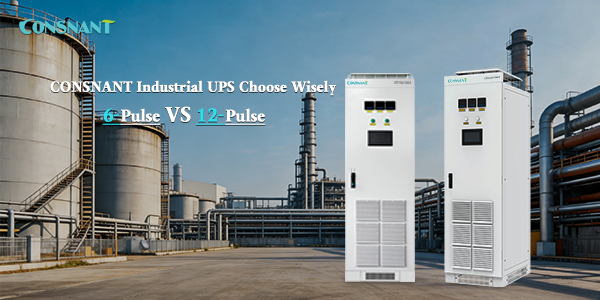
    Based on the application scenarios of Consnant CNI series industrial online UPS, the core differences between 6-pulse and 12-pulse UPS lie in rectifier structure, harmonic suppression capability, grid compatibility, and overall cost. 12-pulse UPS offers superior grid friendliness, stability, and efficiency, making it suitable for harsh industrial environments; 6-pulse UPS, on the other hand, excels in low cost and simple structure, making it suitable for standard scenarios.   1. Core Structural Difference 6-Pulse Rectifier Uses a 6-SCR full-bridge topology, generating 6 current pulses per AC cycle. Simple design, compact size, lower cost.   12-Pulse Rectifier Based on the 6-pulse rectifier, a phase-shifting transformer and a second 6-pulse rectifier bridge are added, for a total of 12 thyristors. The transformer shifts the input voltage phase by 30°, and the two bridges are connected in parallel and superimposed to form 12 pulses/cycle. More complex structure, higher reliability for industrial use.   2. Comparison of Key Performance Characteristics of Industrial UPS Item 6-Pulse 12-Pulse Advantage Input THDi ~25%–30% ~8%–10% 12-Pulse Power Factor (PF) ~0.8 >0.95 12-Pulse Harmonic Profile Dominated by 5th, 7th harmonics 5th, 7th harmonics largely canceled 12-Pulse Grid Impact May cause overheating, interference, generator instability Minimal grid pollution 12-Pulse Efficiency Slightly higher Slightly lower (transformer loss) 6-Pulse Size & Weight Smaller, lighter Larger, heavier 6-Pulse Cost Lower Higher 6-Pulse Redundancy Single bridge Dual-bridge, partial load capability if one fails 12-Pulse   3. Core Advantages of 12-Pulse Transmission over 6-Pulse Transmission (Industrial Scenarios)   a. Ultra-Low Harmonics, Grid-Friendly Significantly suppresses 5th and 7th order low harmonics (a major cause of grid pollution). THDi <10%, meeting IEC 62040-3 industrial standards without additional filters. Protects transformers, generators, and precision instruments in the plant area from harmonic interference.   b. Compatible with Generators and Sensitive Loads 6-pulse transmission with filters can easily lead to generator voltage runaway and shutdown under light loads. 12-pulse transmission is stable across the entire load range, perfectly matching backup generators.   c. High Power Factor, Energy Saving and Cost Reduction PF close to 1, reducing reactive power losses and lowering electricity costs and distribution capacity requirements.   d. Industrial-Grade Reliability and Redundancy Dual rectifier bridge design, strong fault tolerance. Lower ripple, more stable DC bus, extending battery and inverter lifespan.   4. Applicable Scenarios for 6-Pulse (Consnant CIN Basic Version) • General industrial environments with limited budgets, good power grid quality, and no sensitive equipment. • Workshops/factories with stable loads, long-term full-load operation, and low harmonic requirements. • Scenarios with limited space and requiring miniaturized installation.   5. Consnant CNI Series Selection Recommendations • Choose 6-Pulse: Standard operating conditions, cost priority, clean power grid, no precision equipment. • Choose 12-Pulse: Demanding industrial scenarios such as data centers, power plants, chemical plants, semiconductor plants, and medical facilities; projects requiring backup generators, protection of high-precision equipment, long-term stable operation, and high compliance requirements.   Optimize Your UPS: 6-Pulse or 12-Pulse?Contact Consnant for professional solutions.

需要帮忙?与我们聊天

留言
如果您对我们的产品感兴趣,想了解更多详情,请在此留言,我们会尽快回复您。
提交
联系我们 #
0086 13501592453

我们的时间

11 月 21 日星期一至 11 月 23 日星期三:上午 9 点至晚上 8 点
11 月 24 日星期四:关闭 - 感恩节快乐!
11 月 25 日星期五:上午 8 点至晚上 10 点
周六 11 月 26 日至周日 11 月 27 日:上午 10 点至晚上 9 点
(所有时间均为东部时间)

产品

whatsApp

联系

Start a Conversation

Hi! Click one of our members below to chat on